
Digitizing Shellac Records
Updated: Jul 6
Origins and Development
Long before vinyl was used for audio recordings, shellac was the principal material for phonograph records. Shellac is a resinous substance secreted by the lac bug (Kerria lacca) and processed into a hard, brittle compound. Commercial shellac records began in the late 19th century, and the early shellac discs were fragile and limited to very short playing times of around 3 to 4 minutes per side. By the 1910s-1920s, most shellac records adopted a 78 revolutions per minute (rpm) format and were often referred to as "78s." Shellac records peaked from the 1920s to the 1940s, when this format dominated the commercial music market as well as speech, comedy, radio transcriptions, and field recordings.

Digitizing Shellac
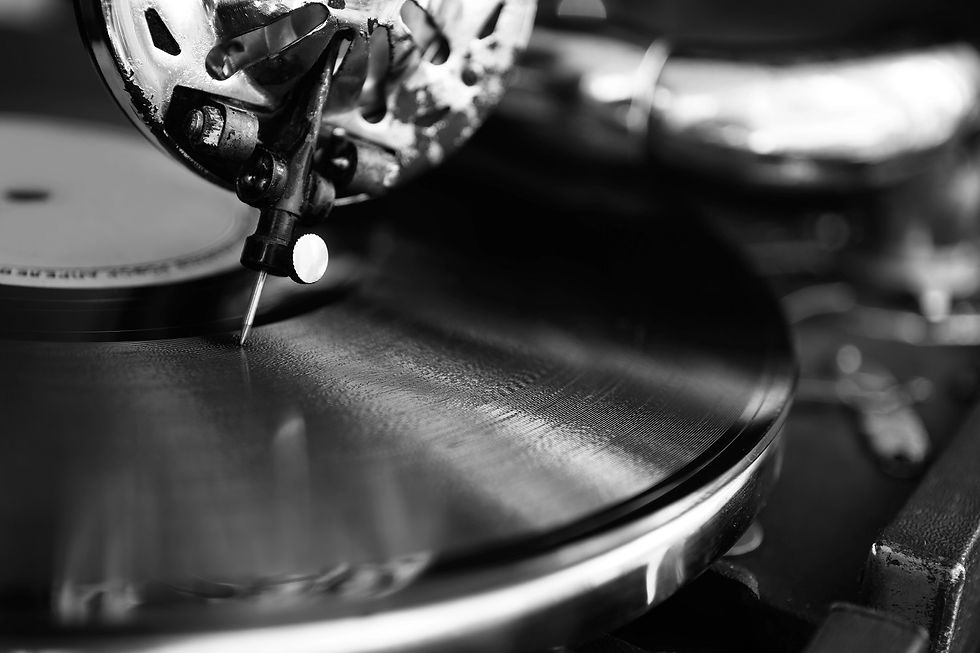
So, what is needed to transfer shellac recordings to digital audio files compared to vinyl records? One key difference is the width of the grooves on shellac records. Shellac records typically require a larger conical stylus, often 2.0 to 3.0 mil tip, to accurately track 78-rpm groove dimensions. Many companies market these special styluses for 78s.
Visual Inspection: Check the shellac material for any cracks, warps, mold, or severe wear.
Use a stylus specifically marketed for 78s or archival work.
Use a soft anti-static brush to remove loose particles. For embedded dirt, apply a disc-specific wet cleaning solution with a pliable cleaning pad. Avoid household cleaners and dry thoroughly before playback.
Playback Hardware

Turntable: Using a stable, high-quality turntable with adjustable speed control is essential. A record clamp or weight will ensure consistent platter contact. Many boutique turntables only provide 33 rpm and 45 rpm, so choose a model with a 78 rpm option.
Cartridge: Since shellac records have wider grooves than vinyl, use a stylus specifically marketed for 78s. Make sure the proper tracking force and alignment per the cartridge specifications are met.
Speed Accuracy: Confirm that the turntable runs at 78.0 rpm. Some records may vary slightly. Higher-end turntables can fine-tune the playback speed.

Preamp and Equalization:
Shellac 78s use varied historical equalization curves that differ from the standardized RIAA curve used for vinyl records.
Apply the correct EQ curve during digitization:
If available, use a software/hardware equalizer with pre-war or specific label curves (e.g., Western Electric, Electric & Musical Industries).
If the exact curve is unknown, start with a neutral/flat capture and correct in post-production. Some shellac records, especially from the 1950s, used 45 rpm.
.
Recording Software & Settings

For the audio interface that captures the digital audio files, select a quality analog-to-digital converter (ADC). Sample rate should be 96 kHz to 192 kHz, with the higher level capturing more detail, such as high-frequency noise and harmonics that can be cleaned later. Bit depth should be 24-bit minimum for better dynamic range and headroom. For software, use a Digital Audio Workstation (DAW) or audio capture tools that support lossless formats and allow real-time monitoring. A popular open-source program is Audacity, which is available for Windows, macOS, and GNU/Linux operating systems. The typical workflow is recording direct from the preamp to a lossless master file (WAV or FLAC). Metadata can be embedded in your audio files to provide details of the digitized recording, such as title, artist, date, label, catalog number, and source condition. These finalized lossless versions can then be converted to lower bitrates for everyday use, such as 320kbps MP3. Remember to back up your digitized project files for redundancy, including a primary archive (local server/storage), off-site backup, or cloud archiving.
Summary and Recommendations
Shellac records are historically rich audio artifacts. While the format provides a unique

listening experience, it does present challenges. Shellac is more fragile than vinyl, and it's prone to chipping, cracking, and surface wear. The record grooves are wider, resulting in greater surface noise compared to later microgroove vinyl, and the frequency response is lower due to limited bandwidth compared to modern recordings. With this in mind, below are the best practices for digitizing shellac.
Prepare physically (clean and inspect).
Use appropriate playback hardware (correct stylus, stable turntable, proper EQ).
Capture at high resolution (96/192 kHz, 24-bit).
Process conservatively (minimal noise reduction, correct equalization).
Document and archive rigorously (metadata and backups).


