
Editing Showdown: Super VHS vs. Betacam SP
Updated: Sep 18

If you were serious about video editing at home in the 1990s, beyond basic camcorder cuts, you eventually ran into a pivotal question: Step up to Super VHS, or go all-in on Betacam SP? Both formats promised better results than standard VHS, but they lived in very different worlds when it came to cost, performance, and practicality. Here's how that decision looked through the lens of a prosumer editor at the time.
The Formats at a Glance
Super VHS (S-VHS)
An upgraded version of VHS designed to squeeze more quality out of consumer gear. It kept the same cassette form factor but improved luminance resolution and overall sharpness. It was backwardly compatible with VHS.
Betacam SP
A full-fledged professional broadcast format. The same system used by TV stations, production houses, and electronic journalism crews—just occasionally accessible to well-funded enthusiasts or small studios.
Equipment Cost: The Reality Check

This is where the decision usually gets made. Super VHS machines were priced from $600 to $2,000. The S-VHS editing decks with flying erase heads, time-base correction, and jog/shuttle were $1,500 to $3,000. Prosumer S-VHS camcorders ranged from $1,500 to $3,000. You could build a complete S-VHS editing setup for under $5,000, sometimes much less, if you bought used gear.

Betacam SP studio decks ranged from $10,000 to $30,000, and used camcorders, even in the late 1990s, were $5,000 to $15,000. Field recorders/edit decks were several thousand more. Even on the secondary market, Betacam SP was a five-figure commitment. For most home editors, it wasn’t just expensive, it was borderline inaccessible. For prosumers, Super VHS was attainable. Betacam SP required either deep pockets or a professional justification.
Tape Cost and Consumables

S-VHS tape prices ranged from $10 to $25 each. Standard VHS tapes were cheaper and could be used in S-VHS decks, but they produced lower quality than S-VHS tapes. Overall, the tape cost was affordable enough to experiment, reshoot, and archive freely.
Betacam SP small-size tapes were $20 to $40 each, but the L-size cassettes were significantly more. Costs added up quickly, especially for multi-generation edits or long-form projects. Budget-wise, S-VHS encouraged iteration, while Betacam SP encouraged efficiency.

Video Quality: How Big Is the Gap?
Super VHS has ~400 lines of horizontal resolution and is noticeably sharper than VHS. It's still composite video, meaning there is some color bleeding, dot crawl artifacts, and limited color bandwidth. For
home editing, it looked very good, especially when using S-Video connections.

Betacam SP has ~340–400 lines, but with component video recording (Y, R-Y, B-Y). This provides much cleaner color reproduction, better contrast, and higher dynamic range. Betacam SP also holds up across multiple generations of editing. This is the key distinction: while resolution numbers look similar on paper, Betacam SP’s component signal path makes it visibly superior in real-world editing. While S-VHS looks great for consumer work, Betacam SP looks broadcast-ready.

Audio Quality
Super VHS offered Hi-Fi stereo (AFM) and had surprisingly good fidelity for home use. But S-VHS had limited control for serious post-production work. Betacam SP had 2-4 channels of professional analog audio. It had independent audio tracks, better metering, and a cleaner signal path. Betacam SP was designed for dubbing, mixing, and post-production workflows. Super VHS audio was "good enough" for prosumer projects, but Betacam SP audio features were built for production.
Editing Experience

For editing features, Super VHS used linear editing (tape-to-tape) with quality loss in each generation. Except for the higher-end decks, S-VHS had limited editing precision, and timecode was often absent or inconsistent across the format. You could certainly edit with S-VHS, but it required careful planning to avoid degradation.
By comparison, Betacam SP offered frame-accurate editing with timecode, minimal generational loss, and was designed for insert edits, assemble edits, and professional workflows. This is where Betacam SP really separated itself. It wasn’t just about quality—it was about control. S-VHS made editing possible, but Betacam SP made it efficient and precise.
Reliability and Durability
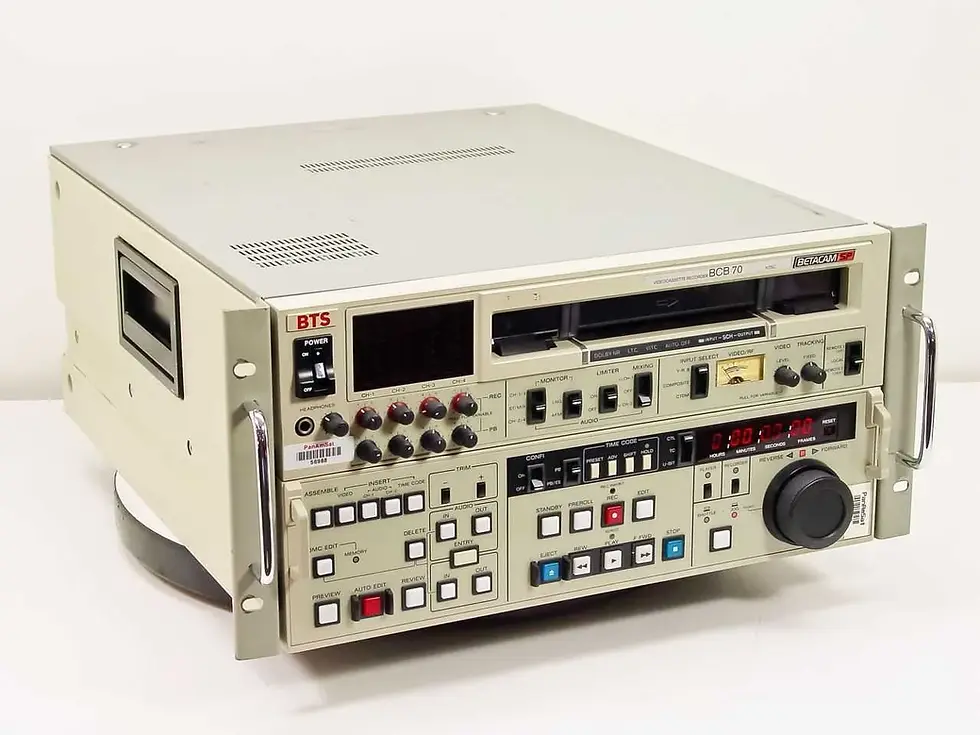
Super VHS had consumer-grade transports (with some prosumer exceptions) and was more prone to tracking issues and wear. Also, tape dropout was more noticeable. Betacam SP offered rugged, broadcast-grade tape decks with higher tape speed and better tape stock. They were extremely reliable under heavy use. Betacam SP was built for daily production environments, while S-VHS was built for occasional use.
What Format Would a Prosumer Choose?
Back in the 1990s, most serious video home editors landed here:
Choose Super VHS if:
You’re building a home editing suite on a realistic budget
You want a clear upgrade over VHS
You can accept some quality loss during editing
Your final output is for home viewing or small-scale distribution
Choose Betacam SP if:
You’re doing paid work or aiming for broadcast-level output
You need reliable, repeatable editing performance
Budget is secondary to quality
You want your footage to hold up over multiple edits
Summary
Super VHS was the prosumer sweet spot—a meaningful leap over VHS without breaking the bank. Betacam SP, on the other hand, was the real deal. It was a professional format that delivered superior color fidelity, editing precision, and long-term reliability, but at a cost that put it out of reach for most video enthusiasts. For many 1990s editors, S-VHS wasn’t the dream; it was the practical choice. Betacam SP was the benchmark everyone measured themselves against.


