
Video8 or VHS: Which is Better?
Updated: Sep 18

For millions of families during the 1980s and 1990s, precious memories were captured on either VHS tapes or Video8 camcorder cassettes. Birthday parties, weddings, vacations, and school performances often live on these aging analog formats today. As these tapes continue to deteriorate with age, many people wonder: Which format was actually better - Video8 or VHS? The answer may surprise you. While VHS became the dominant format for home movie rentals and television recording, Video8 was generally the superior format for recording personal videos. Let's compare these two iconic formats and see how they stack up.
A Brief History
VHS: The Living Room Standard

Introduced by JVC in 1976, VHS (Video Home System) became the world's most popular videotape format. Its long recording times and widespread availability helped it win the famous "format war" against Betamax.
VHS was primarily designed for recording television broadcasts and playing pre-recorded movies on home VCRs.
Video8: The Camcorder Revolution
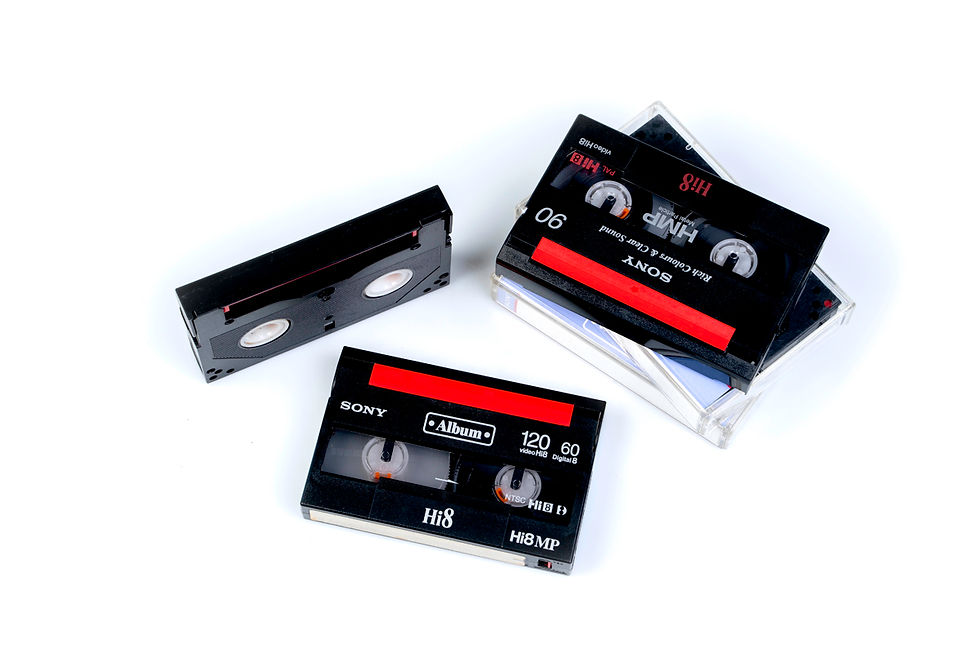
Sony introduced Video8 in 1985 as a compact video recording format specifically designed for camcorders. The smaller cassette size allowed manufacturers to produce lightweight, portable cameras that were far easier to carry than the shoulder-mounted VHS camcorders of the early 1980s. For consumers interested in recording family memories, Video8 represented a major technological leap forward.
Resolution and Sharpness
Winner: Video8
One of the biggest differences between the formats is image resolution.
Format | Approximate Horizontal Resolution |
VHS | 240 lines |
Video8 | 240-280 lines |
Hi8 (Video8 successor) | 400+ lines |
While standard Video8 offered only a modest improvement over VHS on paper, the real-world picture was often noticeably sharper. Video8 used a higher recording bandwidth and was optimized for direct camera recording. As a result, footage typically exhibited:
Better fine detail
Improved edge definition
Less visible video noise
Reduced color bleeding
When viewed side-by-side, Video8 recordings often appear cleaner and more detailed than VHS camcorder recordings made during the same era.
Color Quality
Winner: Video8
Color reproduction is one area where Video8 clearly outperformed VHS.

VHS records color information at a very low bandwidth. This limitation often produces:
Washed-out colors
Color smearing
Reduced color detail
Visible chroma noise
Video8 utilized a more advanced recording system that preserved color information more effectively.
Benefits included:
More accurate skin tones
Richer color saturation
Improved color separation
Less color bleeding around objects
Family videos shot outdoors frequently demonstrate this advantage, with blue skies, green grass, and clothing colors appearing more vibrant and natural on Video8 recordings.
Audio Quality
Winner: Video8
Audio quality was another area where Video8 held a significant advantage.

VHS Audio
Most consumer VHS camcorders recorded audio using a linear audio track located along the edge of the tape.
Typical limitations included:
Limited frequency response
Higher background hiss
Lower signal-to-noise ratio
Susceptibility to dropouts
While VHS VCRs later introduced Hi-Fi stereo audio for television recordings, many VHS camcorders continued to rely on linear audio systems.
Video8 Audio
Video8 used frequency modulation (FM) audio recording integrated into the video signal itself.

Advantages included:
Wider frequency response
Lower noise levels
Greater dynamic range
More consistent audio quality
Many consumers were surprised by how much cleaner and fuller Video8 audio sounded compared to VHS camcorder recordings.
Tape Size and Portability
Winner: Video8
The physical differences between the formats were dramatic.
VHS Cassette
Large cassette
Bulky camcorders
Heavier equipment
Less convenient for travel

VHS 
Compact VHS (VHS-C)
Video8 Cassette
Approximately one-quarter the size of VHS
Compact camcorders
Lighter weight
Easier one-handed operation
The smaller cassette was one of the primary reasons Video8 became so popular among families and hobbyist videographers.
Recording Time
Winner: VHS
VHS offered significantly longer recording times. A standard VHS tape could record:
2 hours in SP mode
4 hours in LP mode
6 hours in EP/SLP mode
Video8 tapes typically provided 60 to 120 minutes of recording in standard mode and 90 to 180 minutes using the Long Play (LP) mode.
For recording lengthy television programs or extended events, VHS had a clear advantage.
Durability and Reliability
Slight Edge: Video8
Both formats are now decades old, but Video8 often ages somewhat better.
The smaller cassette design generally provides:
Better tape protection
Less tape exposure
Reduced contamination risk
However, both formats remain vulnerable to mold growth, tape binder deterioration, magnetic signal loss, and mechanical damage.
Regardless of format, digitization is recommended before irreversible degradation occurs.
Playback Compatibility
Winner: VHS
One reason VHS dominated the market was universal compatibility. Nearly every household owned a VHS VCR. Video8 tapes required a Video8 camcorder, a Video8 VCR, or a Digital8 camcorder with analog playback capability. Today, functioning Video8 playback equipment is significantly harder to find than VHS machines.
Which Format Produced Better Home Movies?
For consumers recording family memories, Video8 was generally the superior technology.
Video8 offered:
✓ Sharper images
✓ Better color reproduction
✓ Cleaner audio
✓ Smaller, more portable camcorders
✓ Improved recording technology
VHS remained the better choice for:
✓ Recording television programs
✓ Longer recording times
✓ Household playback compatibility
✓ Movie rentals and distribution
In practical terms, a well-recorded Video8 tape often looks and sounds better than a VHS camcorder recording made under similar conditions.
Why Digitization Matters Today
Whether your memories are stored on VHS or Video8, the clock is ticking. Magnetic videotape is a fragile storage medium. Every year that passes increases the risk of signal loss, dropouts, mold contamination, and playback equipment failure.
Perhaps the greatest threat is the disappearance of functioning VCRs and Video8 camcorders. Even perfectly preserved tapes become inaccessible when playback equipment can no longer be repaired.
Professional digitization captures the original recording before further deterioration occurs, preserving your family history in modern digital formats that can be easily shared, backed up, and enjoyed for generations. If you have VHS or Video8 tapes stored in a closet, attic, or basement, now is the ideal time to convert them before those irreplaceable memories are lost forever.


