
What Type of Videotape Do I Have?

The Difference Between VHS, VHS-C, Video8, Hi8, and MiniDV
Are you sorting through a box of old home videos but aren't sure what type of tape you're holding? You're not alone. One of the most common questions we hear at TapedMemories is, "What kind of videotape is this?" Many families have recordings from the 1980s, 1990s, and early 2000s, but the labels have faded or were never written in the first place. The good news is that each format has distinctive characteristics that make it easy to identify once you know what to look for. Whether you're preparing to preserve your family's memories or simply trying to determine what you have, this guide explains the five most common consumer videotape formats.
Quick Comparison
Format | Years Popular | Approximate Size | Typical Camcorder | Recording Quality |
VHS | 1977–2005 | Large cassette | Full-size camcorder or VCR | Standard Definition |
VHS-C | 1982–2005 | Small VHS cassette | Compact VHS camcorder | Standard Definition |
Video8 | 1985–1998 | Small 8mm cassette | Sony & others | Better than VHS |
Hi8 | 1989–2005 | Same size as Video8 | Sony Hi8 camcorder | Higher than Video8 |
MiniDV | 1995–2010 | Small digital cassette | Digital camcorder | Digital DV quality |
VHS: The Classic Home Video Tape
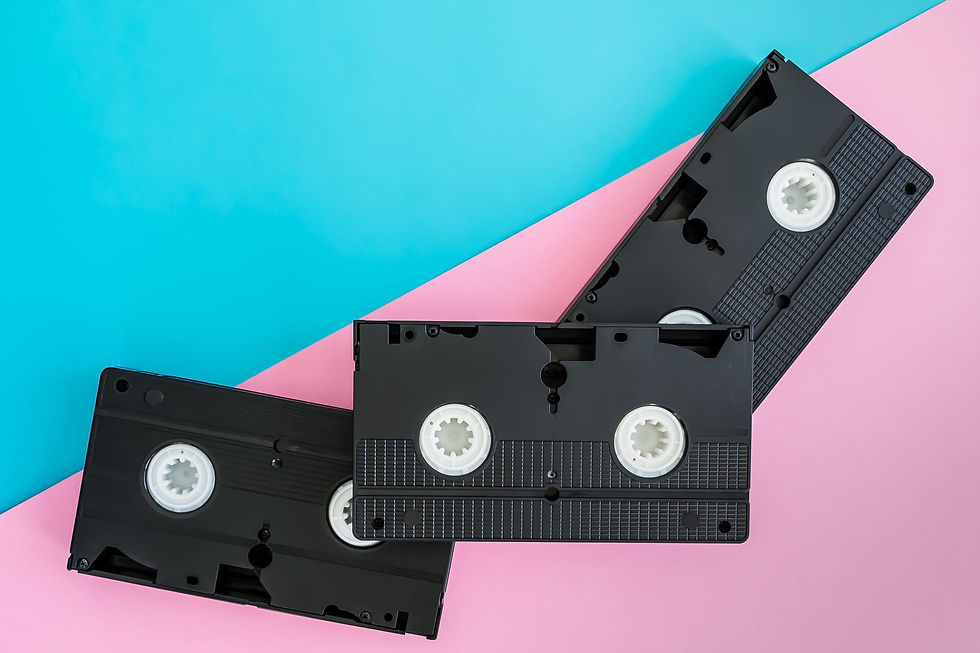
If you rented movies during the 1980s or 1990s, you already know what a VHS tape looks like. A VHS cassette is large, rectangular, and about 7.4 × 4.1 inches. It contains ½-inch magnetic tape and was the dominant home video format for nearly three decades.
Most families used VHS for:
Birthday parties
Christmas mornings
School performances
Vacation recordings
Home movies copied from a camcorder
Because VHS tapes are now 20–45 years old, many are beginning to experience signal degradation, mold, binder deterioration, and playback problems.
VHS-C: A Smaller VHS Tape

VHS-C stands for VHS Compact. Instead of carrying a full-size VHS camcorder, manufacturers created a much smaller cassette that fit into lightweight handheld cameras.
A VHS-C cassette:
Is roughly the size of a deck of playing cards
Uses the same ½-inch videotape as standard VHS
Can often be played in a household VCR using a VHS-C adapter
Many people mistake VHS-C tapes for MiniDV because of their small size, but they're noticeably thicker and wider. A VHS-C recording can usually be transferred directly to a full-size VHS cassette using an adapter and VCR.
Video8: Sony's Compact Alternative

Video8 was introduced by Sony in 1985 as an entirely different recording system, not a smaller version of VHS.
Unlike VHS, Video8 uses:
8mm-wide magnetic tape
A completely different recording method
A much smaller cassette
Video8 tapes are slightly larger than MiniDV but smaller than VHS-C. Many camcorders from the late 1980s and early 1990s used Video8 because they were lighter and produced sharper pictures than VHS camcorders.
Hi8: An Improved Version of Video8
Hi8 looks almost identical to Video8. In fact, many people cannot distinguish them by appearance alone.
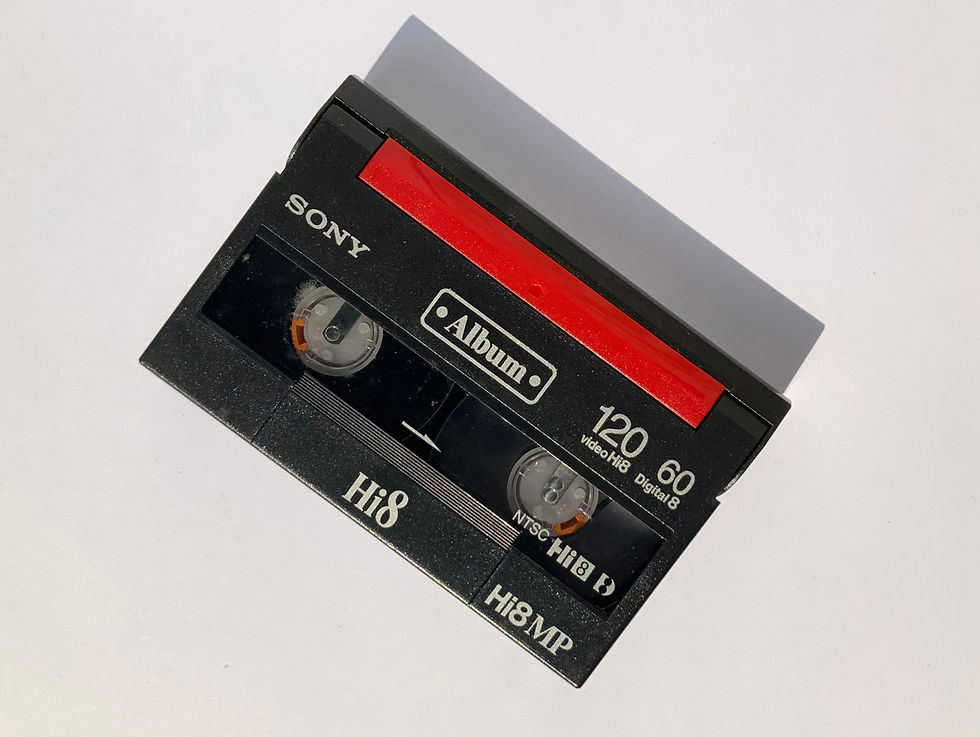
The difference is in the recording technology:
Higher video resolution
Better color reproduction
Reduced image noise
Improved detail
Most Hi8 camcorders can also play older Video8 recordings, making them valuable for playback today. If your tape says Hi8, XR, or Digital Audio, it is likely a Hi8 recording.
MiniDV: The Digital Revolution
MiniDV arrived in the mid-1990s and marked the transition from analog videotape to digital recording.

MiniDV tapes:
Store digital video instead of analog
Produce significantly sharper images
Often include stereo digital audio
Are much smaller than VHS
Although MiniDV is a digital format, the recordings are still stored on magnetic tape. That means they remain vulnerable to age, humidity, mold, and playback equipment failure. Many MiniDV camcorders are no longer manufactured, making working playback equipment increasingly difficult to find.
Identify Your Tape in Under 10 Seconds
Check the label — most tapes say VHS, VHS‑C, Video8, Hi8, or MiniDV.
Compare the size — VHS is huge, MiniDV is tiny, 8mm formats are in between.
Look at the shape — VHS‑C looks like a small VHS; Video8/Hi8 have rounded edges.
Check for adapters — VHS‑C often comes with a plastic adapter shell.
Look for brand clues — Sony = Video8/Hi8/MiniDV; JVC = VHS/VHS‑C.
Which Format Has the Best Picture Quality?
Generally speaking:
MiniDV
Hi8
Video8
VHS / VHS-C
However, picture quality also depends on:
Camcorder quality
Recording speed
Lighting
Tape condition
Playback equipment
Whether professional Time Base Correction (TBC) is used during digitization
A professionally transferred VHS tape can often look better than a poorly transferred Hi8 tape.
Can These Tapes Still Be Played?
In many cases, yes, but there's a catch. Working VCRs and camcorders are becoming increasingly scarce. Many now require servicing due to worn belts, deteriorated rubber components, leaking capacitors, or alignment issues. Even if you still have the original camera, there's no guarantee it will power on or play tapes reliably. Every year, it becomes more difficult to locate functioning playback equipment for these legacy formats.

Why Digitize Now?
Magnetic tape wasn't designed to last forever. Even tapes stored carefully can develop problems such as:
Signal loss
Color fading
Dropouts
Mold growth
Sticky tape
Tracking issues
Digitizing preserves your recordings before deterioration becomes irreversible. Once converted to digital files, your family memories are much easier to view, back up, and share with relatives anywhere in the world.
TapedMemories Transfers All Major Consumer Video Formats
Whether you have one tape or several boxes tucked away in a closet, identifying the format

VHS
VHS-C
S-VHS
Video8
Hi8
Digital8
MiniDV
Betamax
Betacam SP
Digital Betacam
DVCAM
HDV
And many other legacy video formats
Using broadcast-quality playback equipment and professional Time Base Correction whenever appropriate, we help recover the best possible image from your original recordings. Don't wait until the only working camcorder is gone. Preserve your family's memories while they can still be played.


